Use our tool to see historical market performance
What's a mutual fund?
A mutual fund is a collection of investors’ money that fund managers use to invest in stocks, bonds, and other securities.
Learn more about mutual funds
Why invest in mutual funds?
Mutual funds can be particularly suitable for investors seeking long-term, tax-deferred growth in retirement accounts.
Low costs
Our average expense ratio across our mutual funds and exchange-traded funds (ETFs) is 84% lower than the industry average.
Less risk through diversification
Mutual fund diversification helps reduce risk by spreading your investment across a range of securities, so underperformance in one area can be offset by better performance in others.
Professional management
You don't have to keep track of every security your mutual fund owns. The fund is managed by experts who take care of that for you, so you're free to focus on other things.
Convenience
You can buy and sell mutual fund shares online and set up recurring investments and withdrawals.
Vanguard mutual fund options
Vanguard offers a range of mutual funds to invest in, designed to serve different investment goals and risk tolerances. Here’s an overview of our 4 main types of mutual funds.

Index funds
Enjoy the benefits of diversification, tax efficiency, and low costs with index mutual funds.
Actively managed funds
Our careful selection of talent, paired with our consistent investment approach and client-first focus, sets our actively managed mutual funds apart.

Target Retirement Funds
You make just one decision, and the fund’s managers maintain the target risk and handle rebalancing for you.

ESG funds
Invest in what matters to you. Our ESG (environmental, social, governance) funds allow you to invest in funds that align with your personal preferences.
Choose from more than just Vanguard funds
Access thousands of investments from other fund companies and hold them in one Vanguard account. We offer many no-transaction-fee (NTF) funds.
Mutual funds vs. ETFs
Mutual funds and ETFs (exchange-traded funds) are similar in many ways, but there are a few key differences that set them apart.
ETFs
An ETF is a collection of hundreds or thousands of stocks, bonds, or other securities, managed by experts, in a single fund that trades on major stock exchanges.
- You can buy and sell ETFs throughout the trading day and get real-time pricing, just like stocks.
- Vanguard ETFs have a $1 investment minimum. Minimums for all other ETFs are set at the share price.
- ETFs are generally more tax-efficient than mutual funds.
- We offer both index and actively managed ETFs.
Mutual funds
A mutual fund is a collection of stocks, bonds, or other securities, managed by experts, in a single fund that’s bought and sold at the end of each trading day based on its net asset value (NAV).
- You can place buy or sell orders for mutual funds throughout the trading day. However, these trades are processed and priced at the end of the day at NAV.
- Investment minimums can range from $1,000 to $50,000, depending on the fund.
- Mutual funds are generally less tax-efficient than ETFs.
- We offer both index and actively managed funds.
2 ways to open an investment account
Do it yourself
Both industry experts and everyday people rely on our high-performing,2 low-cost mutual funds and ETFs. Choose from diverse investments to save for your financial goals.

Explore professional advice
Whatever you’re working toward, we have a range of services to help you get there. Get a personalized plan and judgment-free guidance to keep you on track.
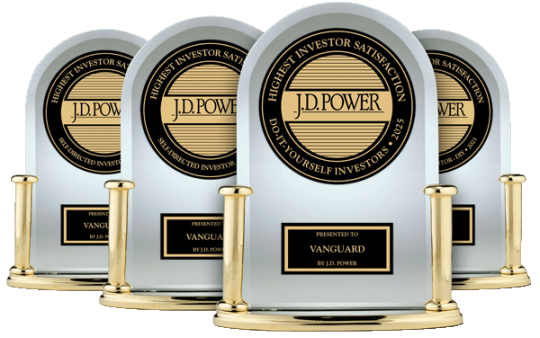
#1 in DIY investor satisfaction for the 4th time by J.D. Power
Ranked highest and named “Most Trusted” in the J.D. Power 2025 U.S. Investor Satisfaction Study. Vanguard has won this award 4 out of 5 years.
For J.D. Power 2025 award information, visit jdpower.com/awards . View methodology
Investing for everything it's worth
Invest according to your goals
Money market funds
Other investment products
Helpful resources

Retirement
Retirement income: Spending your savings

Retirement
5 steps for retirement planning

Taxes
Effective tax-saving strategies for investors

Planning for retirement
Planning for health care in retirement
Frequently asked questions
What is the difference between having access to an advisor and access to a dedicated advisor?
Having access to an advisor means you can speak with someone from our advisory team, as needed, while access to a dedicated advisor means you work with one specific advisor who knows your full financial situation and provides ongoing personalized guidance.
What’s included in personalized financial planning?
A personalized financial plan created by dedicated advisor—who is also a Certified Financial Planner™ (CFP®)—typically includes a comprehensive and tailored approach to your financial life. Here’s what is generally included:
- A clear roadmap for your goals, like retirement or major purchases.
- An investment strategy aligned with your risk tolerance and timeline.
- Tax-smart approaches to help you keep more of what you earn.
- Ongoing updates as your life changes, so your plan stays on track.
What does an investment advisor do?
An investment advisor helps you create and manage a plan to reach your financial goals. They provide guidance on investments, tax strategies, and ongoing adjustments as your life changes.
Does Vanguard provide free investment advice?
Although we don’t provide free investment advice, we do have helpful educational resources available to all investors at no cost.
Will I have access to 24/7 customer service?
While we don’t have 24/7 phone or chat services, you can access your account online anytime. Our investment professionals are available by phone to help with your questions Monday through Friday from 8 a.m. to 8 p.m. Eastern time. Depending on the advice service you select, you also may have a dedicated advisor to contact.
What is automated investing?
Automated investing uses digital platforms to build and manage your portfolio based on your goals and risk preferences, giving you control, convenience, and confidence without the complexity of doing it all yourself.
1For the 10-year period ended December 31, 2025, 6 of 6 Vanguard money market funds, 72 of 104 Vanguard bond funds, 21 of 23 Vanguard balanced funds, and 176 of 193 Vanguard stock funds—for a total of 275 of 326 Vanguard funds—outperformed their Lipper peer-group averages. Results will vary for other time periods. Only mutual funds and ETFs (exchange-traded funds) with a minimum 10-year history were included in the comparison. Source: LSEG Lipper. The competitive performance data shown represent past performance, which is not a guarantee of future results. View fund performance.
For more information about Vanguard funds or ETFs, visit vanguard.com to obtain a prospectus or, if available, a summary prospectus. Investment objectives, risks, charges, expenses, and other important information about a fund are contained in the prospectus; read and consider it carefully before investing.
Vanguard ETF Shares are not redeemable with the issuing Fund other than in very large aggregations worth millions of dollars. Instead, investors must buy and sell Vanguard ETF Shares in the secondary market and hold those shares in a brokerage account. In doing so, the investor may incur brokerage commissions and may pay more than net asset value when buying and receive less than net asset value when selling.
All investing is subject to risk, including the possible loss of the money you invest.
Advice services are provided by Vanguard Advisers, Inc., a registered investment advisor, or by Vanguard National Trust Company, a federally chartered, limited-purpose trust company.
The services provided to clients will vary based upon the service selected, including management, fees, eligibility, and access to an advisor. Find VAI’s Form CRS and each program’s advisory brochure here for an overview.
VAI and VNTC are subsidiaries of the Vanguard Group Inc. and affiliates of Vanguard Marketing Corporation. Neither VAI, VNTC, nor its affiliates guarantee profits or protection from losses.
Research our firm with FINRA’s BrokerCheck.
Investment Adviser Form Client Relationship Summary (Form CRS) (PDF)
Broker-Dealer Form Client Relationship Summary (Form CRS) (PDF)